How Digital Marketing Transformed My Practice (Full Interview & Takeaways)
Introduction
Most clinics do not struggle because they lack good medical services. They struggle because patients cannot consistently find them online.
That was the situation Dr. Riya faced before working with The Smart Growth.
Despite running a well-established dental clinic in Delhi, appointment inquiries remained inconsistent. Some weeks were fully booked, while others were unexpectedly slow. Paid ads generated traffic, but long-term patient growth remained unpredictable.
In this interview-style case study, Dr. Riya shares what changed after implementing a structured digital marketing strategy focused on local SEO, Google Maps visibility, patient conversion, and automation.
This is not just a story about rankings or website traffic. It is about building a more reliable patient acquisition system.
Meet the Doctor — Background & Problem Statement
Dr. Riya, a practicing dentist in Delhi, runs a five-chair clinic with a small admin team. Before working with us she faced:
Irregular patient inquiries and an unpredictable appointment pipeline
Heavy spend on short-term paid ads with poor long-term value
Low visibility for “dentist near me” and other high-intent local searches
A website that looked good but didn’t convert visitors to booked patients
Her goals were simple but urgent: increase appointment volume, reduce ad waste, and build a predictable pipeline for new patients.
The Turning Point — Why Digital Marketing for Doctors Worked
The Smart Growth implemented a combined strategy: SEO, local optimization, conversion-focused website improvements, and automation. Below are the elements that made the difference and why they worked.
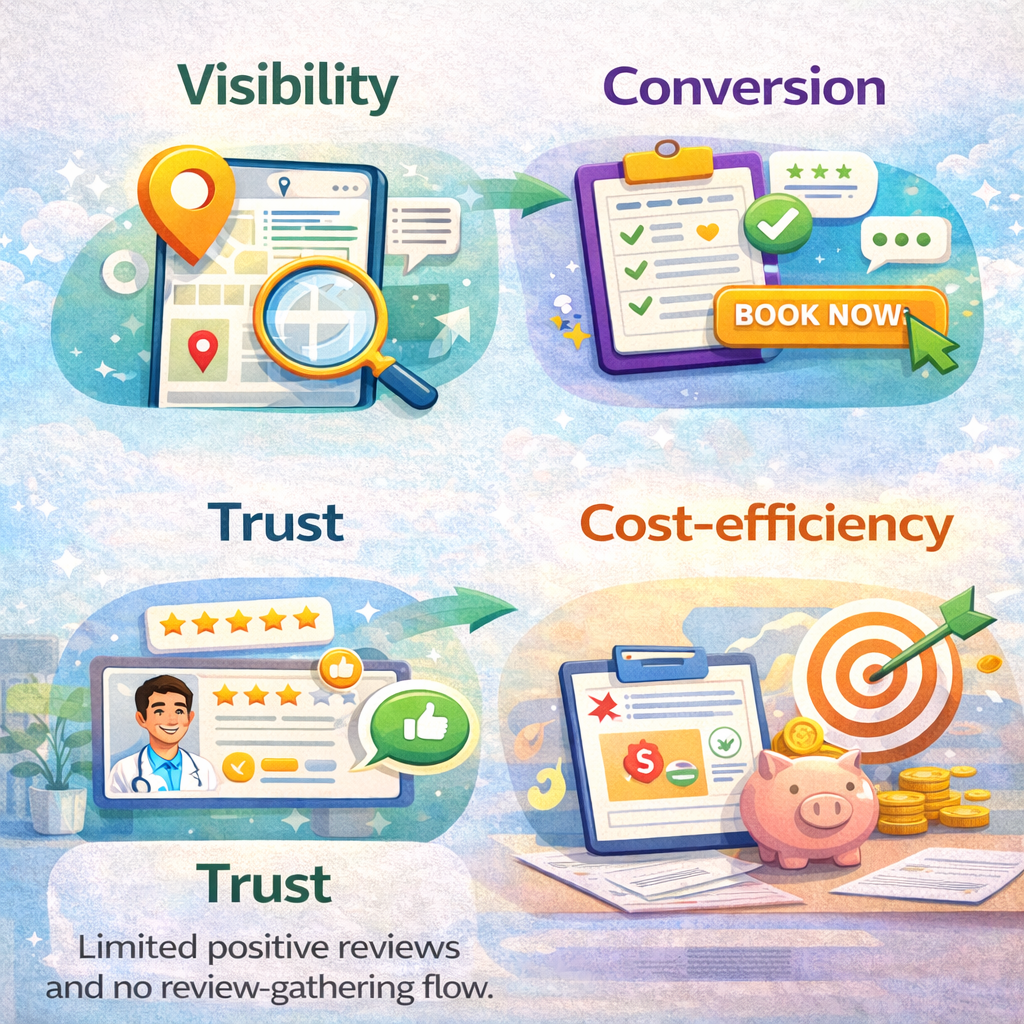
Key Challenges Addressed
Visibility: Clinic pages were not ranking for crucial local keywords.
Conversion: Website visitors had no easy way to book or get quick answers.
Trust: Limited positive reviews and no review-gathering flow.
Cost-efficiency: Poor ad targeting led to low ROI.
What We Did — Strategy & Execution (step-by-step)
1. Rapid Site & Conversion Audit (Week 0–1)
Full technical SEO audit (crawlability, indexability, schema)
UX review on booking flow (reduce friction from landing to booking)
Baseline: tracked monthly organic queries and paid ad conversion cost
2. Local SEO First (Week 1–4)
Optimized Google Business Profile (GBP) with correct NAP, categories, services, photos
Implemented service-location landing pages tailored to high-intent searches
Added local schema (Service + FAQ + LocalBusiness) to key pages
3. Content + Authority (Week 2–12)
Published three pillar articles (treatment pages + long-form guides)
Created FAQ sections on service pages to capture “people also ask” queries
Built a local backlink campaign (citations, local directories, health portals)
4. Conversion & Automation (Week 4–8)
Added WhatsApp click-to-chat + chatbot for 24/7 lead capture
One-click booking integrated with calendar & reminder SMS
Review automation: post-visit review request workflow
5. Paid Ads Re-structured (Week 6–12)
Shifted budget to high-intent campaigns (clinic + service keywords)
Added call-only campaigns and location bid modifiers
Set tighter negative keyword lists and conversion tracking
6. Continuous Optimization (Months 3–6)
A/B tested booking page CTAs and form length
Weekly reporting and adjustments
Quarterly strategy reviews with clinic team
Results — What Happened (90 Days & Beyond)
3× increase in monthly appointment inquiries within 90 days.
Lower cost per booked appointment — paid ads became more efficient as organic pipeline grew.
Higher conversion rate on website visits due to simplified booking and chat.
Improved local rankings — multiple service pages appeared in the local pack for high-intent keywords.
Sustainable pipeline: After 6 months, organic + GBP leads contributed 60% of new bookings (reducing dependence on paid ads).
Benefits — Why This Approach Works for Doctors
Predictable growth — steady improvement in organic visibility builds compounding benefits.
Lower marketing waste — better targeting + automation reduces ad spend leakage.
Better patient experience — faster responses and simpler booking improve conversions and referrals.
Higher trust signals — more reviews and localized content increase click-through and bookings.
Operational efficiency — less admin time spent on calls and manual confirmations.
Benefit bullets
Consistent monthly appointment volume instead of seasonal spikes
Reduced cost-per-patient-acquisition via focused ads + organic lift
Improved patient retention with automated follow-ups
Stronger online reputation through review automation
What Clinics Can Learn From This Case Study
Many clinics face the same problem:
- inconsistent patient flow
- weak local visibility
- dependence on referrals or ads
The biggest lesson from this campaign is that healthcare growth today depends on combining:
- Local SEO
- Conversion optimization
- Reputation management
- Fast patient communication
- Helpful content
When these elements work together, marketing becomes more predictable and sustainable.
Features & Services Delivered (what clinics receive)
Local SEO & GBP optimization
Technical SEO and schema implementation
Content strategy: pillar pages, FAQs, localized service pages
Paid search management focused on patient acquisition
Booking automation (website + WhatsApp + calendar sync)
Reputation management and review automation
Monthly reporting and conversion optimization
Process / How We Work with Clinics (practical & transparent)
Discovery call — goals, constraints, and KPIs.
Audit — 30–60 point technical and conversion audit.
Roadmap — 90-day action plan with milestones and expected outcomes.
Implementation — coordinated sprints (SEO, content, automation, paid).
Optimization — data-driven changes; weekly reporting.
Scale — expand channels once unit economics prove out.
Common Questions from Doctors (FAQs)
How quickly can clinics see results?
Paid campaigns can generate inquiries quickly, while SEO and local visibility improvements usually take 3–6 months.
Does local SEO really help doctors?
Yes. Most patients search locally before booking appointments, making local SEO one of the biggest growth channels for clinics.
Can small clinics compete online?
Absolutely. Strong local SEO and better patient experience often help smaller clinics compete effectively.
Why are reviews important?
Reviews improve patient trust, Google rankings, and appointment conversion rates.
Is SEO better than Google Ads?
SEO creates long-term visibility, while Google Ads help generate immediate inquiries. Combining both usually performs best.
Key Takeaways from Dr. Riya’s Interview
Prioritize local SEO + GBP — this is the first source of patient intent traffic.
Fix conversion friction on the website before scaling paid ads.
Use automated messaging (WhatsApp + chat) to capture late-hour leads.
Build a review-generation process to strengthen local trust.
Track appointment attribution (which channel led to booking) and optimize accordingly.
Ready to Transform Your Practice?
If you’re serious about turning online visibility into predictable appointments, we can help. Our approach combines digital marketing for doctors best practices with real-world automation that reduces admin load and improves patient experience.
Next steps:
Book a free 30-minute audit and action plan.
We’ll send a short checklist, a baseline audit, and a 90-day roadmap.
Contact us:
📞 +91 9315091922